The cheap house is the one nobody wants. That is the whole story of this market.
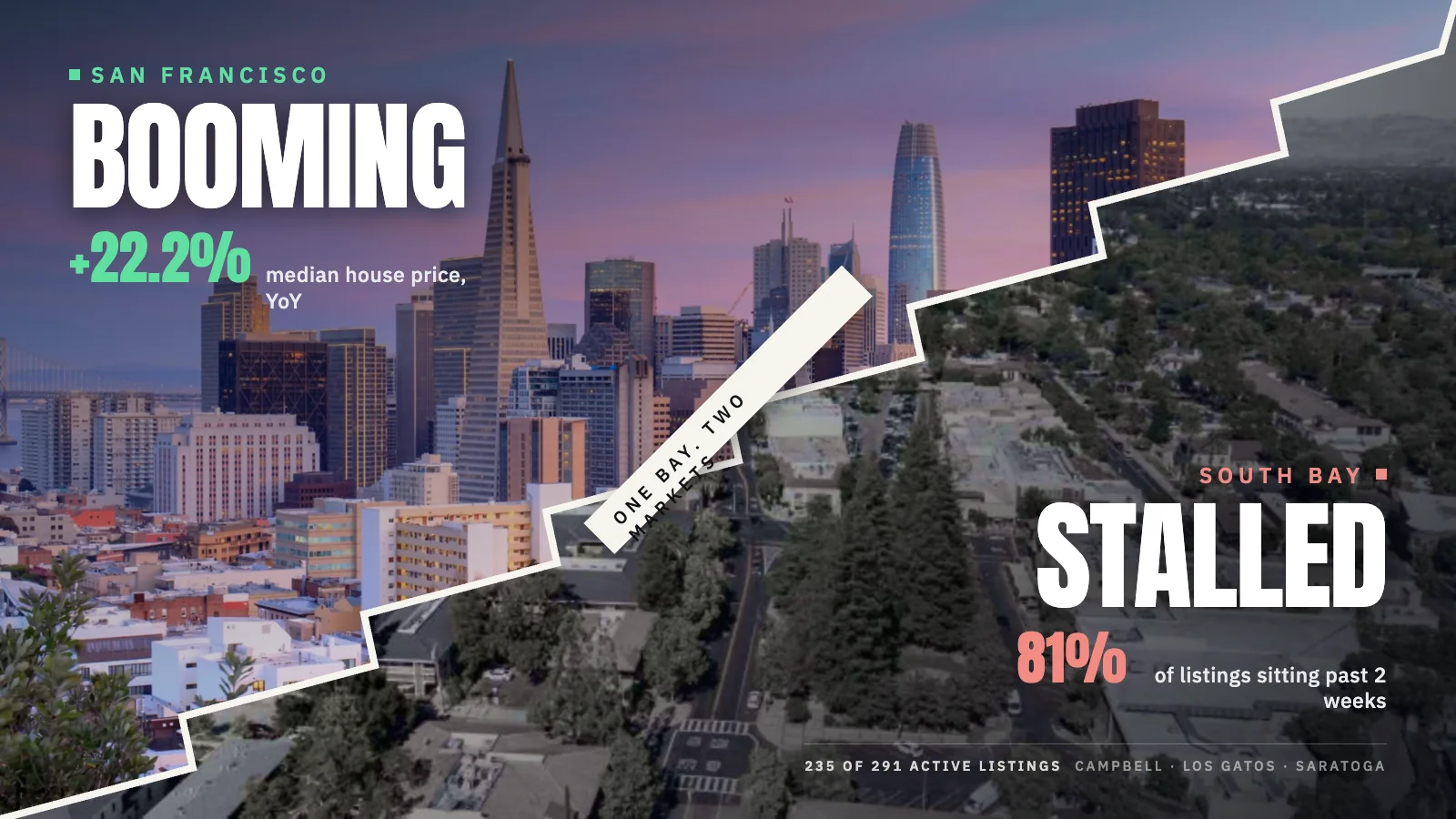
Two housing markets sit forty minutes apart on the same freeway, and right now they are moving in opposite directions.
San Francisco is having the kind of year people write books about. Reporting by Propmodo and Bloomberg has the median single-family price up 22.2% year over year, to $2.2 million — a record, and past the April 2022 peak. Condos, written off for three years, are up 27%. In the first half of this year 144 San Francisco homes sold for at least $1 million over asking. In the same period last year, eight did.
All of it powered by the same thing: AI equity landing in one city faster than that city can produce houses to absorb it. Secondary share sales, pre-IPO liquidity, and the expectation of more to come.
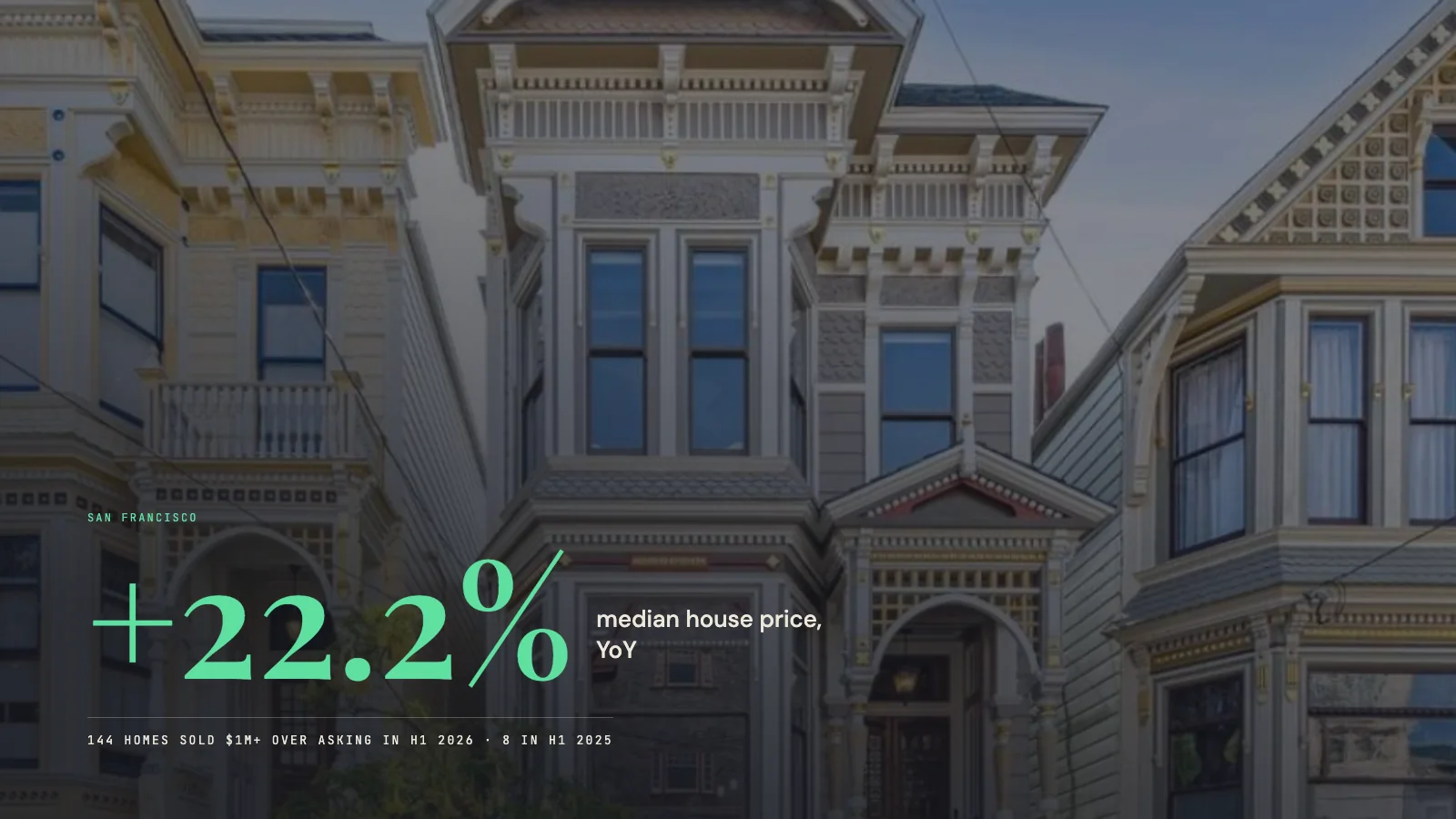
San Francisco. 144 homes sold at least $1 million over asking in the first half of this year. In the same period last year, eight did.
Drive south and it feels like a different economy, because it is one.
The South Bay does not run on AI equity. It runs on Big Tech salaries — and Big Tech is doing something it has not done at this scale in a decade. It is cutting, and it is cutting while telling shareholders that AI is why the headcount does not need to come back. Whatever that means for the industry, for this housing market it means one thing: the buyer pool for a $1.6 million house in Campbell is full of people who are not sure they will be employed in March.
Here is what that looks like in the listings, and it is not what anyone predicts when they hear "layoffs."
Three quarters of the market is sitting
Of 90 active listings in Campbell right now, 71 have been on the market more than two weeks. That is 79% of everything for sale.
Fourteen days is my threshold and it is not arbitrary. In a market with real competition, a correctly priced house in this city goes into contract inside two weekends. It gets one full weekend of open houses, offers come the following week, done. When a listing crosses day fourteen, one of three things is true: it is priced above what the market will pay, it has a condition or location problem the photos hide, or the seller has become emotionally attached to a number. Every one of those is a negotiation.
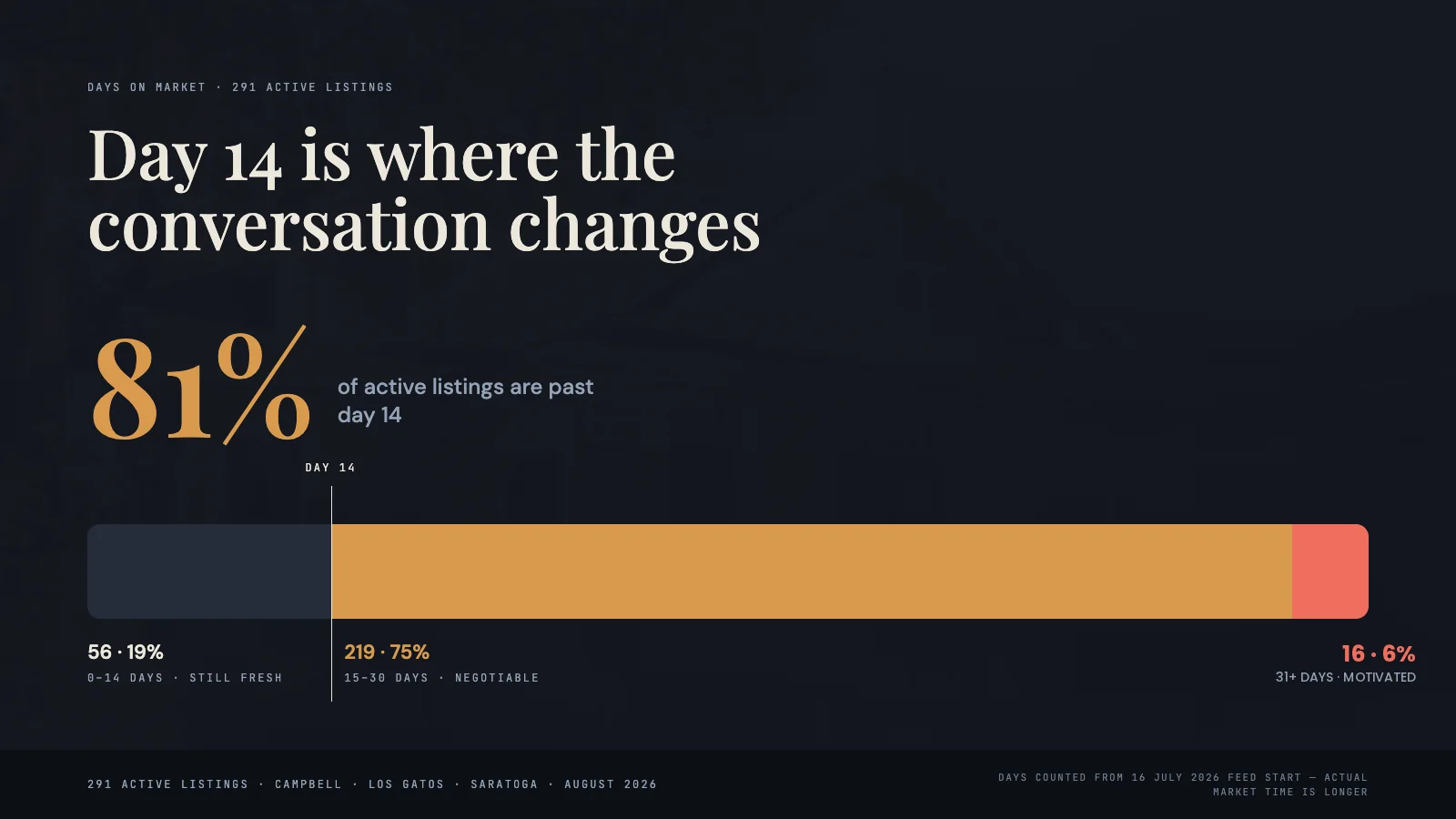
Fourteen days is the line. Past it, a listing is a negotiation.
Three quarters of the market being past that mark is not a slow week. It is a market where the buyer sets the terms.
Now the part that surprised me
Here is where the obvious story breaks. Sort the same listings by price and absorption runs backwards.
| Price band | Active | Share already pending or sold |
|---|---|---|
| Under $2M | 69 | 26.6% |
| $2M–$3M | 14 | 70.8% |
| $3M–$6M | 7 | 66.7% |
| $6M+ | 0 | —% |
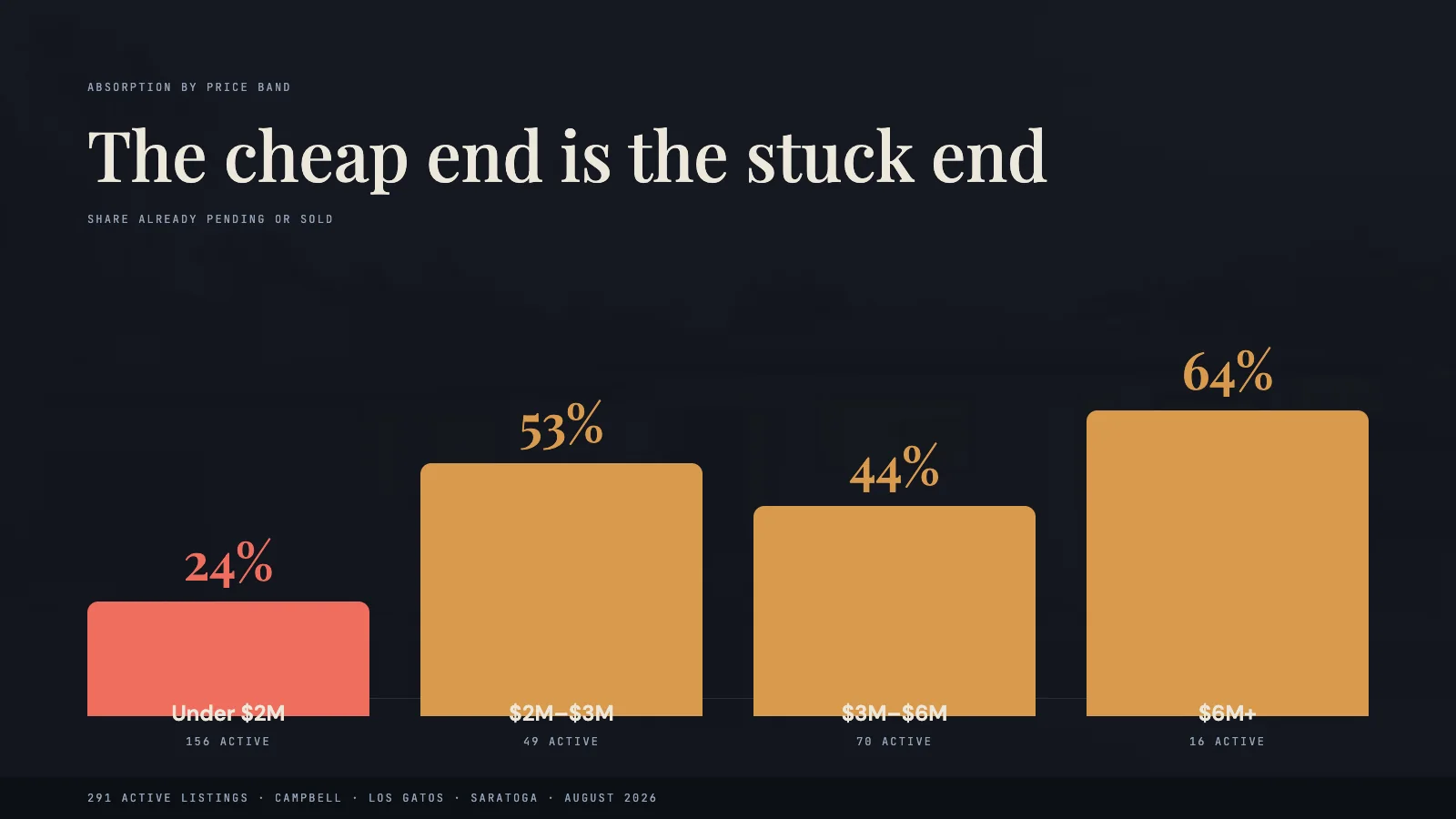
Absorption rises with price. Everyone expects a downturn to hit the top first.
Read that column twice. The cheap end is the stuck end.
Everybody assumes a downturn hits the top first. Luxury is discretionary, the theory goes, and the entry level is where the desperate buyers are. This market is doing the exact opposite, and once you see why, it is obvious.
The buyer for a sub-$2M house in this city is a first-time or second-time buyer whose entire purchase depends on two things: a salary that feels safe and a mortgage rate they can live with. Both of those have moved against them. They are financing 70 or 80 percent of the price, so a rate in the high sixes is not an inconvenience — it is the difference between qualifying and not. And they are watching their employer cut a division a quarter. That buyer has not left the market. They have paused, and a paused buyer looks exactly like a missing buyer to anybody trying to sell them a house.
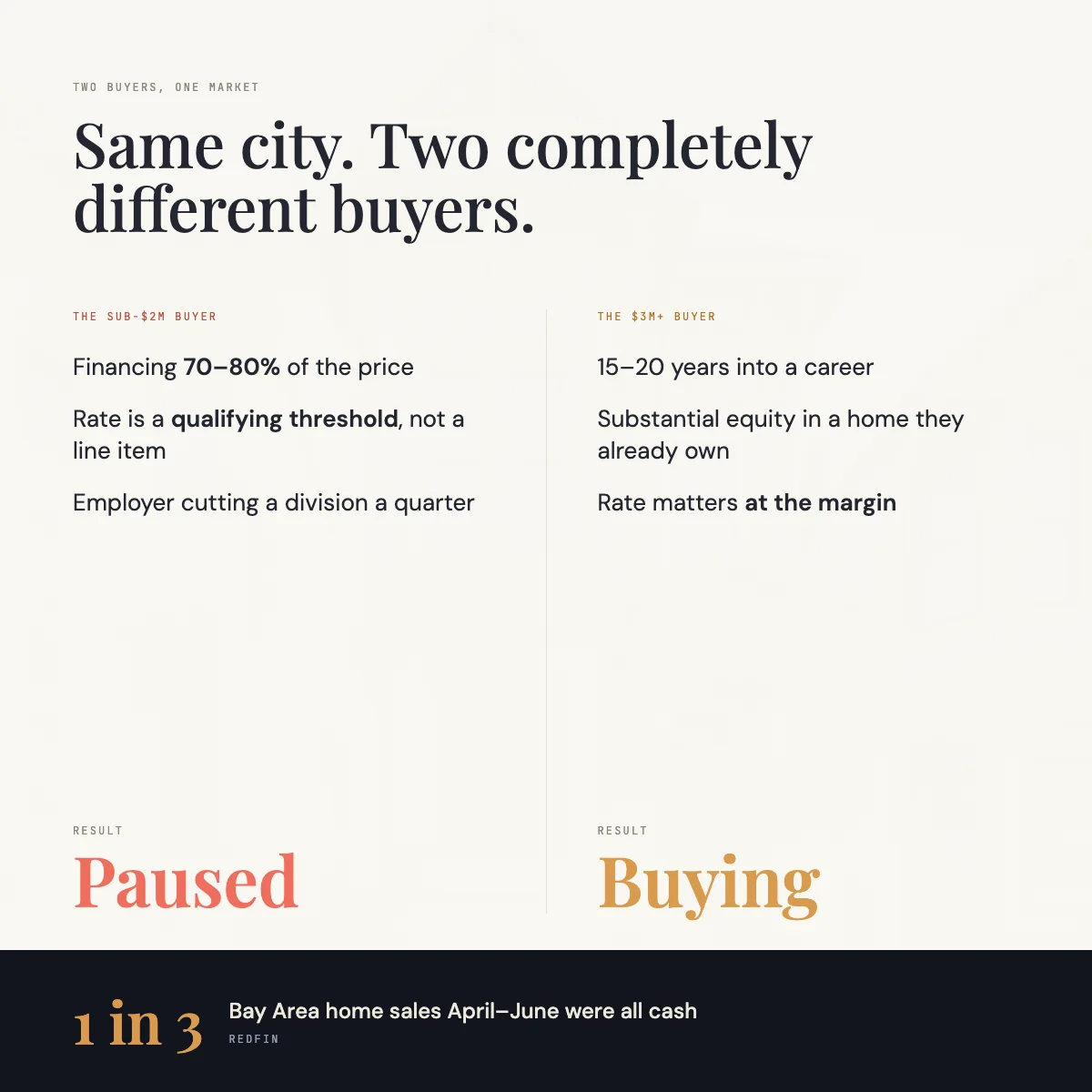
One is buying on a salary and a rate. The other is buying on equity.
The buyer at $3M and up is a different person entirely. Fifteen or twenty years into a career, substantial equity in a house they already own, often a meaningful share of the purchase coming in cash. Rates matter to them at the margin rather than at the threshold. They are not asking whether they can buy. They are asking whether now is the moment.
And the answer they are arriving at, apparently, is yes.
The trade-up window
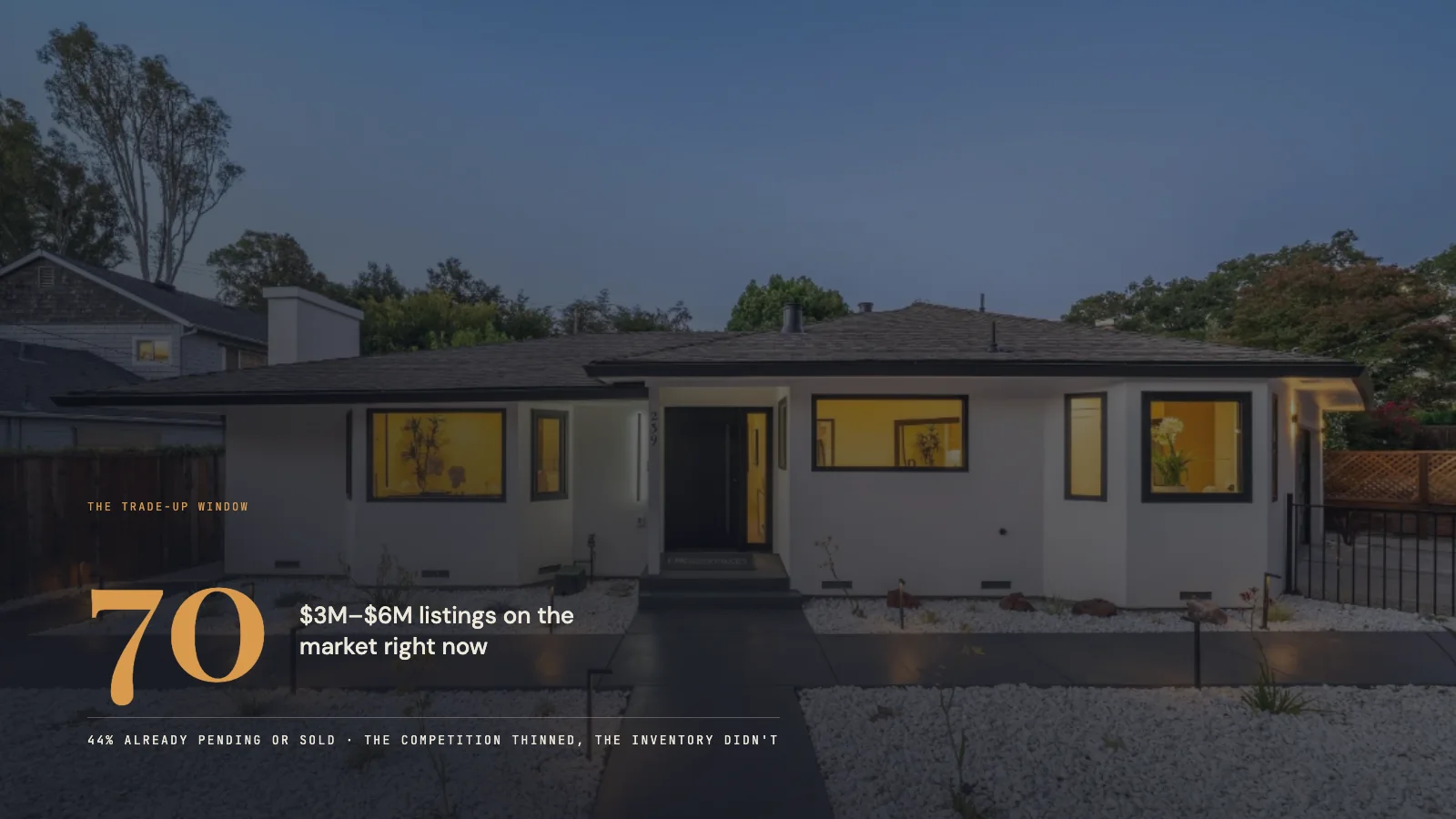
The trade-up window. 70 listings between $3M and $6M across the three markets, and 44% of that band is already pending or sold.
This is the trade almost nobody is naming out loud, so I will.
The classic trade-up — sell the starter house, buy the one you actually want — has been miserable for four years. You were competing against ten offers, waiving everything, and paying over ask for the privilege. That is not the market you are walking into today at $3M to $6M in Campbell.
The competition thinned because the rate environment removed the leveraged buyers, not because the houses got worse. If you have equity and liquidity, you are shopping against far fewer people than you were in 2022, for the same inventory.
The catch, and it is a real one: you probably have to sell into the slower half of this market to buy into the faster one. That is a genuine cost. It is also why the people getting this done are the ones who can carry both for a while, or who are bringing enough cash that the sequencing does not have to be perfect.
Cash is doing more work than usual
Redfin put about one in three Bay Area home sales between April and June as all cash. That is the number to hold onto, because it explains who is actually winning right now.
In a normal market, cash buys you a small discount and a faster close. In this one it buys leverage, because the seller of a listing on day thirty is not comparing your offer to five others. They are comparing it to another two weeks of silence.
An offer with no loan contingency, a short inspection window and a fourteen-day close is worth real money against a stale listing — often more than the same seller would have taken from a financed buyer at a higher number, because certainty at day thirty is worth more than optimism at day forty-five.
That is not a new insight. What is new is how many listings are old enough for it to apply.
Where I would look
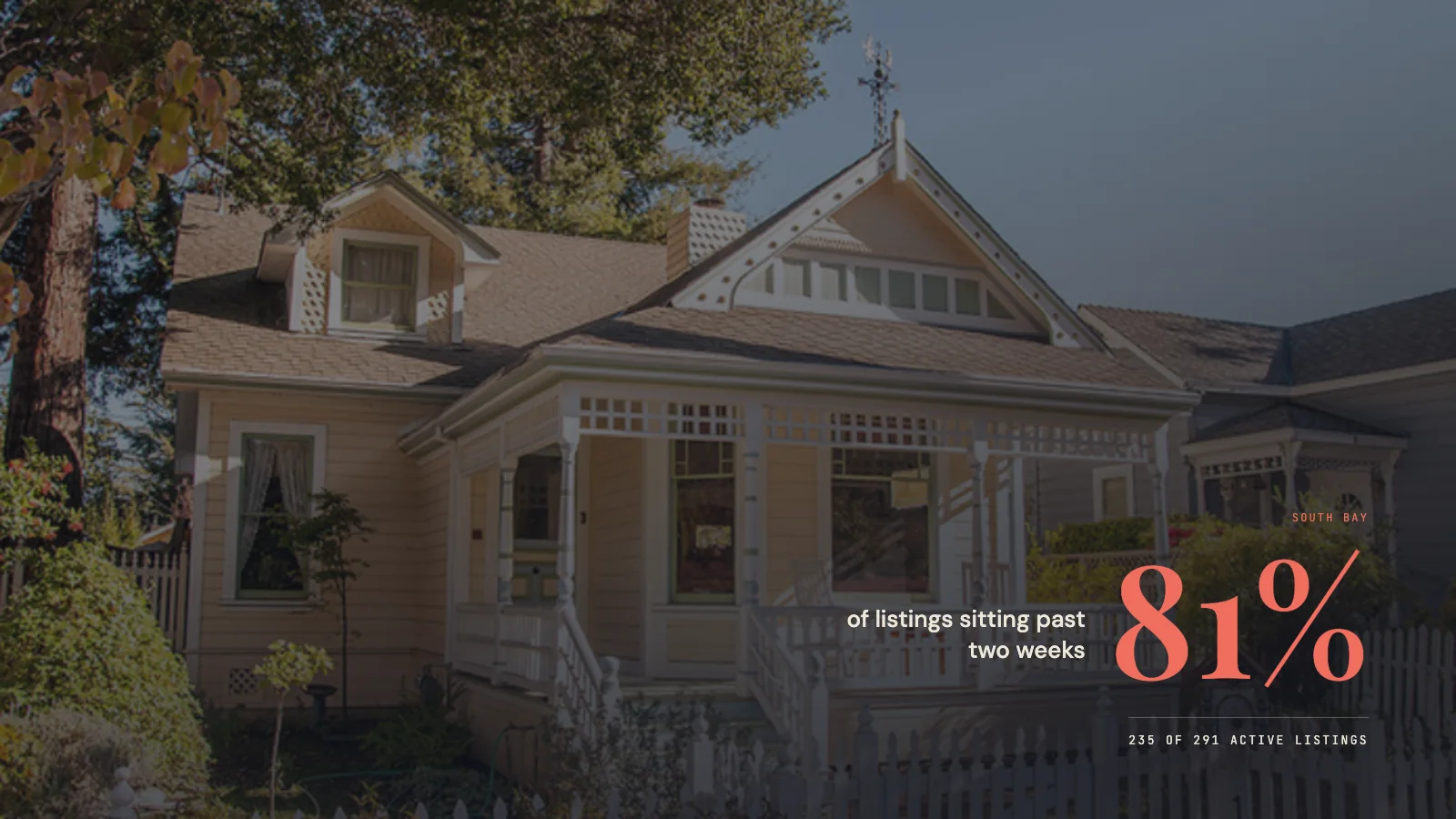
235 of 291 active listings across the three markets have sat past the two-week mark.
Aged inventory is where the deals are, and there is a lot of it. In Campbell, 5 listings between $3M and $6M have been sitting past the two-week mark. The median asking price across all aged inventory here is $1,649,000.
A listing at day thirty has usually had one price reduction and is contemplating another. The seller has been through a month of weekend disruption. Their agent has had the uncomfortable conversation. That is a very different negotiation from the one you have on a house that came out last Thursday — and it costs you nothing to find out.
I would rather write on a house that has been available for five weeks than fight four other buyers for one that came out yesterday. The five-week house is not worse. It is just further along the road to a realistic price.
What the numbers do and do not say
Eighty-one percent of this market is sitting past two weeks. That is not a forecast or a feeling. That is a count, pulled today, and it is the number that should be driving every conversation you have with an agent this month.
One honest note on the price bands: some of them are a dozen or two listings in a single city. In isolation that is an anecdote. Across all three markets at once, pointing the same direction, at the same time — that is a pattern. I would bet on the direction. I would not price your house off a single cell.
And I will not tell you Big Tech layoffs caused this, because rates alone explain a great deal of it and anyone claiming certainty is selling something. What I will tell you is what I hear across kitchen tables when the offers do not come, and it is not "interest rates."
What to actually do
Buying under $2M? You have more leverage than you have had since 2019 and almost nobody has told you. Before you ask about schools, before you ask about the roof, ask one question: how long has it been available? If the answer is over two weeks, you are not a buyer any more. You are the only buyer.
Trading up into $3M–$6M? This is the window. The competition thinned because rates pushed the leveraged buyers out — not because the houses got worse. That reverses the moment rates ease, and it reverses fast. Look hard at anything past day twenty-one, and bring the cleanest terms you can afford. Certainty beats price on a listing that has been sitting.
Selling in the entry tier? Price it for August 2026, not for the spring your neighbour caught in 2022. You get two weekends of real leverage and then you join the 82% — and the 82% do not get their leverage back, they just sell later for less. The reduction you are resisting today is smaller than the two you will make in October.
Own it and staying put? None of this is about you. Listings sitting is not value falling — it is transaction volume pausing. People confuse those two constantly and it costs them in both directions: panic-selling into a slow market, or refusing a strong offer because they read a scary headline.
One last thing, because it is the whole piece in a sentence. In this market the cheap house sits and the expensive one sells. That is backwards from everything you have been told about how a slowdown works, and the people who figure out why first are going to buy very well this autumn.
If you want to know how long a specific house has actually been available — not what the listing says, what the record says — that is a phone call, and it is free.
Tim McMullen · CA DRE #02016832
[email protected] · (415) 691-9272
- https://propmodo.com/ai-wealth-fuels-bidding-wars-and-million-dollar-premiums-in-san-francisco-housing/ · Propmodo
- https://www.bloomberg.com/news/articles/2026-04-06/san-francisco-house-prices-hit-record-2-15-million-on-ai-boom · Bloomberg
- https://us.cnn.com/2026/08/17/economy/sf-real-estate-ai-wealth · CNN Business
More from Campbell
Campbell's only October 13 listing asks $1.6 million
A single townhouse at 107 Platform Way appeared on the MLS feed on October 13. No pendings, no recorded closings.
This Campbell Condo Is Listed $8,000 Below the Last Sale in Its Own Building
Among eight active small condos in Campbell, this 1-bed, 704-square-foot unit at 185 Union Ave is listed lowest by price and lowest by the dollar — $20,000 under the next ask in the same building.
Campbell's priciest comparable listing asks $790K above its nine-home peer median
The newly built 5-bedroom on Virginia Avenue ranks last by price among nine similar active listings in Campbell. Its $1,165-per-square-foot ask sits above the median recorded sale price for comparable homes over the past 12 months.